
Classic English Scones with Raisins

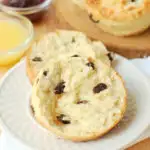

I can guarantee this is an authentic English scone recipe. I used it for 7 years when I worked in a British tea shop, and I got the personal approval of the shop owner’s British mum.
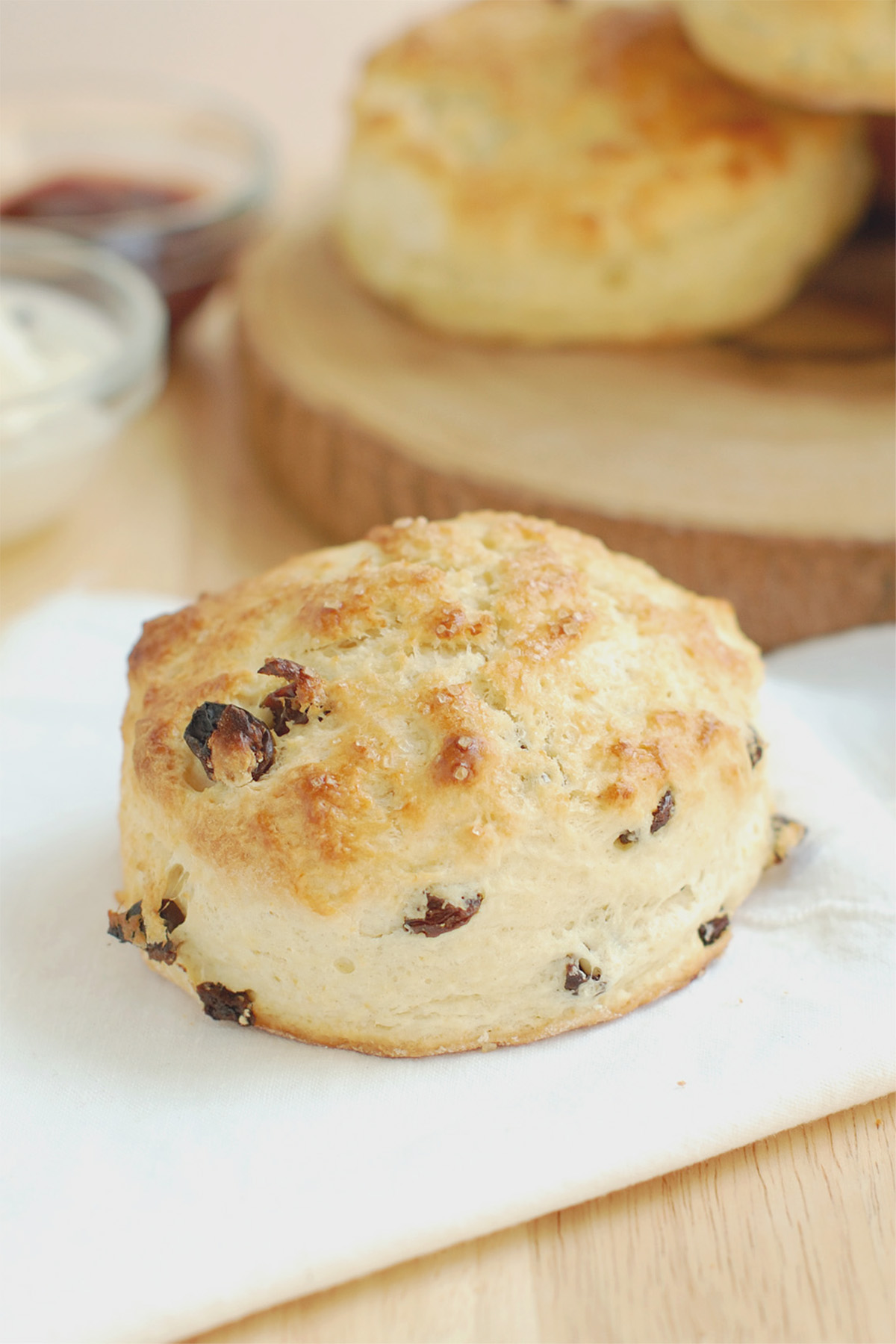
I’ve adapted it for a US kitchen — different flour, different measurements — but the result is the same light, tender scone I made thousands of times behind that counter.
If you’re looking for plain scones, just leave out the raisins.
English Scones vs. American Scones
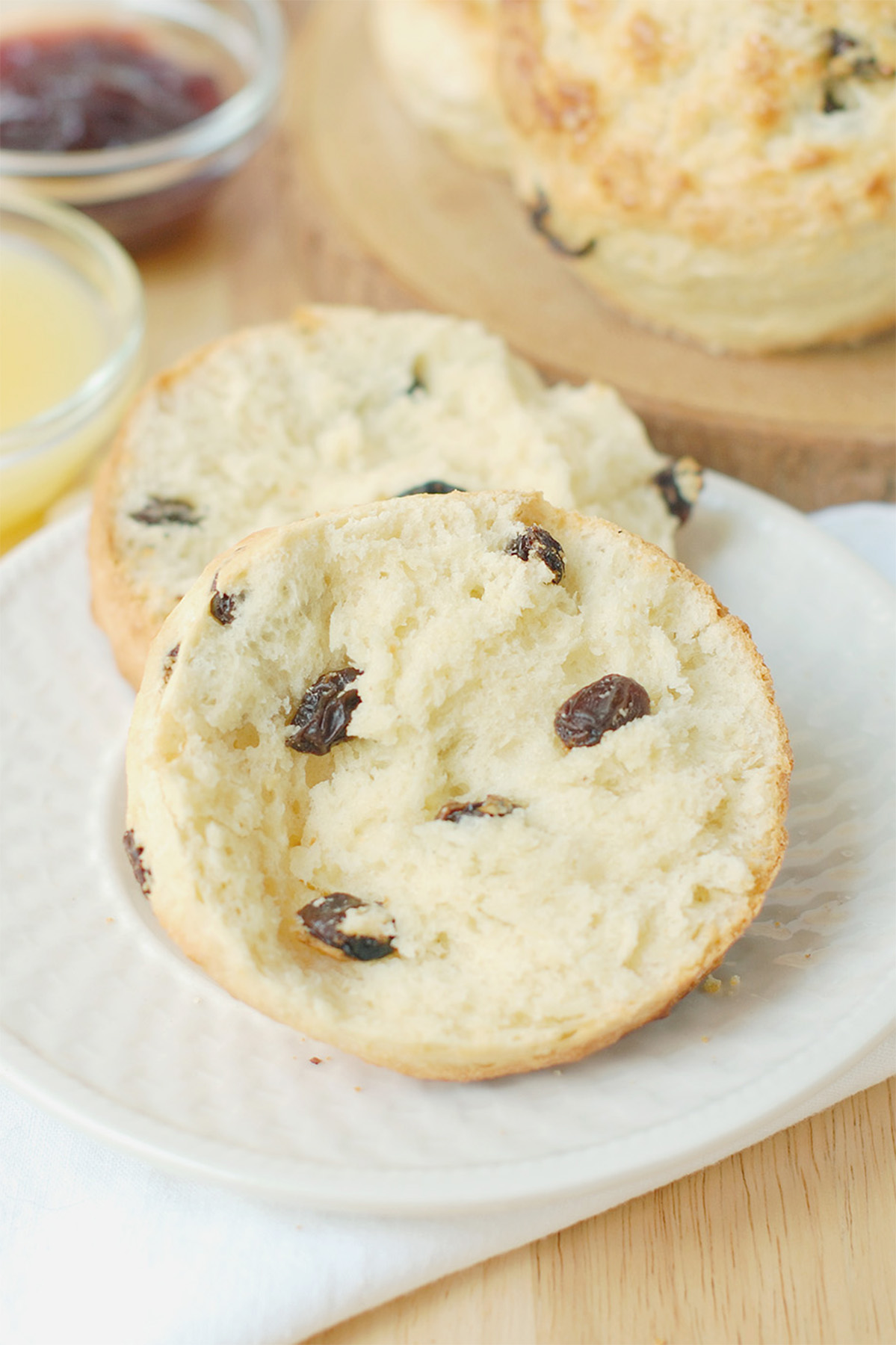
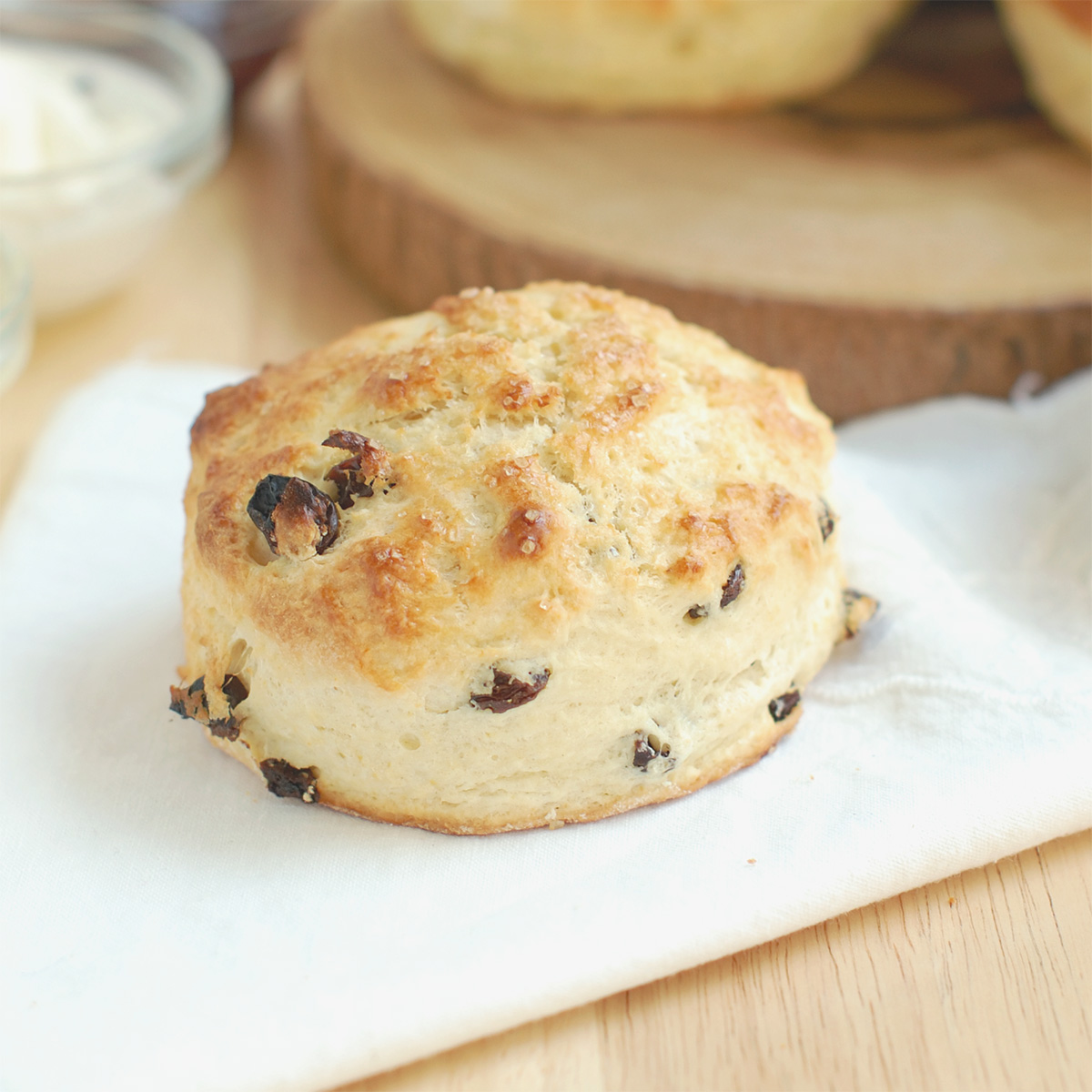
A good English scone falls somewhere between an American biscuit and a muffin — less flaky than the one, less sweet and cakey than the other. It’s not a vehicle for toppings so much as a partner to them. The classic combination of clotted cream and jam only works because the scone itself is restrained enough to let those flavors lead.
Scones have been a staple in Britain for centuries. In America they’re a more recent arrival, gaining ground with the coffee shop boom of the last 20-odd years. As often happens, we Americans adapted the scone to suit local tastes — softer, sweeter, richer, made to be eaten out of hand rather than split and topped.
That’s not a bad thing. American scones have their place, and some of my own recipes fall squarely in that tradition — my Banana Scones and Pumpkin Scones are sweeter and more richly flavored than anything you’d find in a British tea shop.
Personally, I push back on the plethora of glazes, drizzles, and mix-ins that turns a scone into a cupcake with better posture.
Whether you’re going British or American, a scone is not dessert. I keep the sweetness well below cookie territory, and I think the results are better for it.
Scones vs. Biscuits
There’s no official “definition” for scones vs. biscuits. To confuse things further, in Britain a ‘biscuit’ is what Americans would call a cookie — so a British person reading this section would find the whole comparison rather puzzling.
But here I’m comparing American biscuits to scones in general.
Unlike either British or American scones, American biscuits tend to have no or minimal sugar. They definitely lean savory rather than sweet. They’re generally served as a bread rather than a snack or treat. American biscuits don’t typically include eggs, which give the crumb of a scone a lighter, cakier texture.
Ingredients
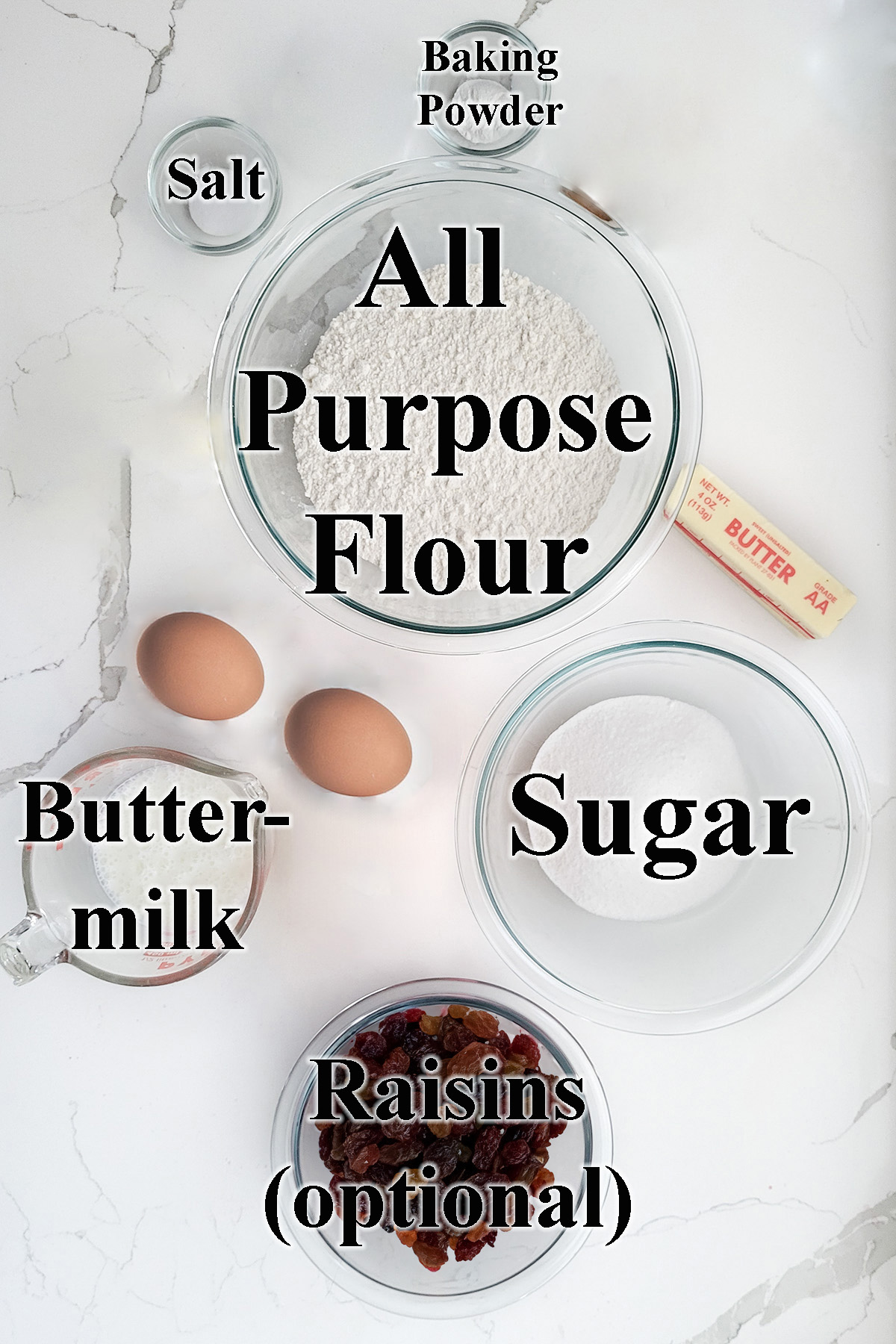
Ingredient Notes
- All purpose flour – Medium protein all purpose flour makes a scone that has enough structure to rise high in the oven, but also has a tender crumb.
- Butter – I always use unsalted butter. If you use salted butter reduce or eliminate the salt listed in the recipe.
- Buttermilk – Acidic buttermilk tenderizes and flavors the scones. Fresh buttermilk is preferred. Buttermilk powder is the best substitute.
- Sugar – For these British scones, there’s just enough sugar to lightly sweeten and tenderize the dough.
- Eggs – Eggs add moisture, structure and create a slightly cakey texture that sets a scone apart from a biscuit.
- Raisins – The raisins are optional, but they do add another layer of gentle sweetness.
The Technique: Why it Matters
The mixing technique is simple by design — every step is there to protect the texture.
- Cutting in the cold butter leaves bits of butter scattered throughout the dough to melt in the oven, making a slightly flaky and crumbly texture. Room temperature butter would coat the flour, preventing it from absorbing the buttermilk and eggs. Because the dough is then too moist, the scones spread in the oven and bake up dense rather than flaky.
- Gentle hand-mixing keeps the dough tender and maintains the air created by the leavening. “Double acting baking powder” produces an initial burst of gas when it comes in contact with the wet ingredients. We want to handle the dough gently to maintain that leavening.
- Patting the dough out by hand instead of using a rolling pin ensures the dough won’t be over worked.
- When you cut the scones, whether in a round or wedge, use a straight, clean cut to encourage the scones to rise straight and tall in the oven.
Process Photos
Here’s what the recipe process looks like at each stage. Refer to the recipe card below for measurements and exact instructions.
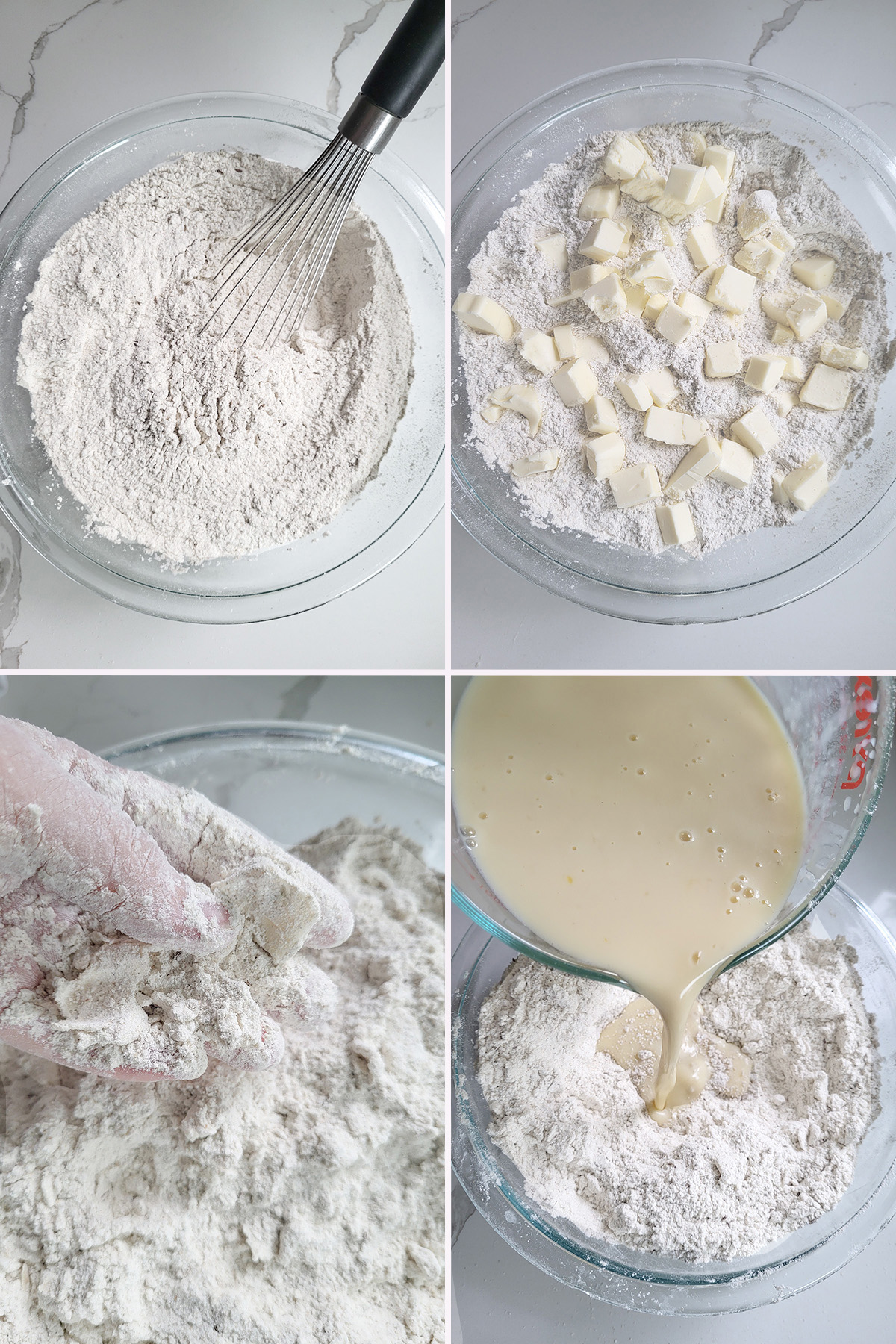
- Whisk together the dry ingredients in a large mixing bowl.
- Work the butter into the dry ingredients by squeezing the cubes into flat flakes. Sprinkle the optional raisins over the dough.
- Pour the buttermilk mixture into the flour base.
- Mix with a spoon or spatula until the ingredients are about 2/3 combined.
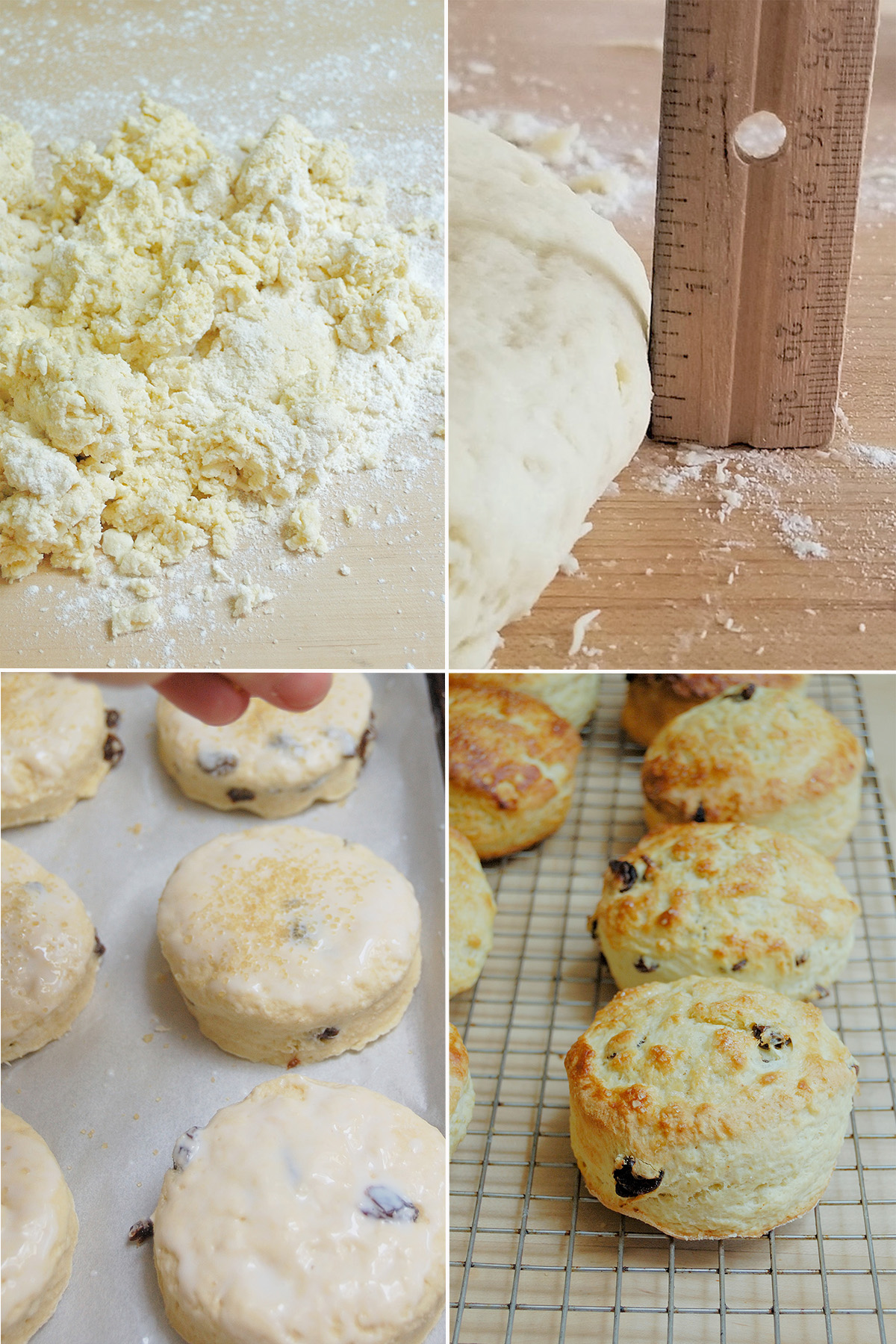
- Turn the dough out onto a well-floured surface.
- Knead a couple of times to bring the dough together. As soon as all the flour is absorbed, stop kneading.
- Use your hands to pat the dough to 3/4″-1″ thick and cut rounds with a biscuit cutter. Line the scones onto a parchment lined pan.
- Bake until golden brown and they feel light when you lift one.
Baker’s Tip: Sticky Hands?
When you mix a wet dough by hand, resist the urge to rinse your sticky hands under the faucet — it’ll just make it worse. Instead, dip your hands in the flour bin to coat. Rub them together over the trash bin. The flour grabs the sticky dough and rolls right off, leaving your hands dry and ready to keep working.
Work Ahead Tips
- The dry ingredients can be whisked together and held at room temperature for several days.
- The wet ingredients can be combined and refrigerated overnight.
- The fully mixed and cut scones can be held in the refrigerator for several hours or overnight before baking.
Storage
Scones are best the day they’re baked but will keep for 1-2 days at room temperature. Never refrigerate baked scones as they will stale faster. Scones can be packed into bags and frozen for up to 3 months. Warm the scones in a 200°F oven to revive the texture.
How to Serve-Afternoon Tea
There’s a difference between “high tea” and afternoon tea. High tea is not, in fact, the “fancy” tea. High tea is a light, evening meal served at the dining table.
Afternoon tea is the “fancy” version and is served earlier in the day. A full afternoon tea has four components— tea, finger sandwiches, scones, and delicate cakes and sweets.
Here’s how to set up a traditional afternoon tea:
- Arrange the components on separate serving plates or use a 3 tier dessert stand.
- For the first course serve dainty tea sandwiches. These should be placed on the bottom tier of the stand.
- Place the scones with clotted cream, lemon curd and preserves on the second tier.
- Small fancy pastries and cookies go on the top tier. Shortbread, Petite Fours and Bakewell Tart are perfect for afternoon tea.
But don’t wait until you plan a tea party to make scones. They are quick enough to make for weekend breakfast. Top them with butter or a little jam for a perfect breakfast or snack.
English Style Scone Recipes
These scones are all variations on the classic scone recipe. Sweet and savory add-ins take the place of the raisins.
- Irish Cheddar & Scallion Scones
- Rye & Caraway Scones
- Sweet Corn Scones
- Homemade Scone Mix the classic recipe adapted for your pantry
- Sourdough Scones the same classic recipe with sourdough discard for flavor
American Style Scone Recipes
These American style scones are slightly sweeter and richer than the classic scone. Still delicious, not too sweet and great for breakfast or a snack.
If you love this recipe as much as I do, I’d really appreciate a star rating and a quick comment. Ratings and comments help my recipes show in search results. Thanks!

English Scones Recipe
Ingredients
- 25 oz unbleached all purpose flour (5 cups, see note)
- 2 tablespoons baking powder
- 4 oz granulated sugar (½ cup)
- ½ teaspoon table salt
- 6 oz unsalted butter (cold, cut into 1″ chunks)
- 4 oz raisins (¾ cup, optional)
- 2 large eggs
- 14 oz buttermilk (1 ¾ cups)
- Demerara Sugar for sprinkling
Instructions
- Preheat the oven to 375 °F. Line two ½ sheet pans with parchment paper or a silicone baking mat.
- In a large mixing bowl, whisk together 25 oz unbleached all purpose flour, 2 tablespoons baking powder, 4 oz granulated sugar and ½ teaspoon table salt. Toss in 6 oz unsalted butter chunks. Mix in the butter using your fingers to flatten the pieces into flakes. Sprinkle 4 oz raisins over the mix.
- Whisk together 14 oz buttermilk and 2 large eggs. Add the buttermilk mixture to the dry ingredients all at once and mix until just barely combined. Some loose flour may remain at the bottom of the bowl. DON'T OVER MIX.
- Dump the dough onto a floured surface. Finish kneading by hand just until all the loose flour is absorbed. Use your hands to pat the dough until it is ¾"-1" thick. Use a 2 ½-3" biscuit cutter to cut scones. Re-roll the scraps and continue cutting until all the dough is used.
- Line the scones onto the prepared baking sheet, leaving 1" space between. Brush the tops with buttermilk and sprinkle with Demerarra or granulated sugar.
- Bake on the middle racks of the oven, flipping the trays after 10 minutes (see note).
- The scones are ready when they are golden brown and feel light when lifted. Total baking time 15-20 minutes.
Would you like to save this recipe?


As an Amazon Associate and member of other affiliate programs, I earn from qualifying purchases.
Hello! I absolutley love your recipe, just baked it, and I plan to make it again in the future. Yet, I had an issue; even when they were dine, sounded hollow, the top was extremely pale. I used granulated sugar and buttermilk but maybe not enough of it? Or maybe my oven just runs too cool as I did have to bake it longer than written. If you have any tips to darken the tops more, please let me know! Thank you!
Usually if you brush the tops with buttermilk they do get nice and brown. Do you have a thermometer in your oven? Perhaps the temp isn’t calibrated. Do you have a convection setting for your oven? If so, that will help with browning.
@Eileen Gray, I figured out what I did wrong. I accidently forgot salt which wasn’t a big deal for me because it tasted great without it. After a bit of research I found out that salt binds with gluten, which then makes the dough more elastic and hold more liquid. So, as I forgot it, the insides finished faster than the top could brown. I did use some left over dough and overcooked it and it did brown but the insides were much too overcooked.
I’m also purchasing a thermometer soon, to double check the temperature within the oven.
Thanks for the great recipe!
Hi Eleen
I am from Malaysia and a new to try to baker by my own ,i have scones so much and will try your recipe to make by my own , before i start to bake few question as below need to guide line:-
1. When to mix the buttermilk and eggs to the dough are we using spatula to mix it .
2. I can’t get buttermilk in Malaysia any suggestions.
Regards
Lio
Yes, use a spatula or wooden spoon to mix. Can you get powdered buttermilk? If no, you could try using thinned down yogurt or sour cream.
Fabulous recipe and easy to make.
I just made these. ⭐️⭐️⭐️⭐️⭐️
Excellent, easy to make and they were gobbled up right out of the oven.
Highly recommend this recipe.
Hi Eileen,
I do love scones and like the sound of your recipe. I’m from Scotland in the UK and would like to bake these scones according to the UK recipe you mentioned . Could you please post it for me. Thank you!
The original recipe is one I got at a tea shop I worked at 30 years ago. It’s long gone.