
Vanilla Macarons
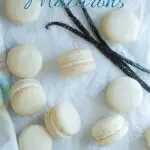
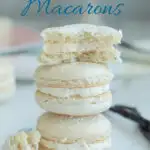
Vanilla Macarons are the base recipe I use for developing and testing all of my flavored French macarons. This version focuses on technique—how the batter should look, how the shells should behave in the oven, and how small changes affect the final result.
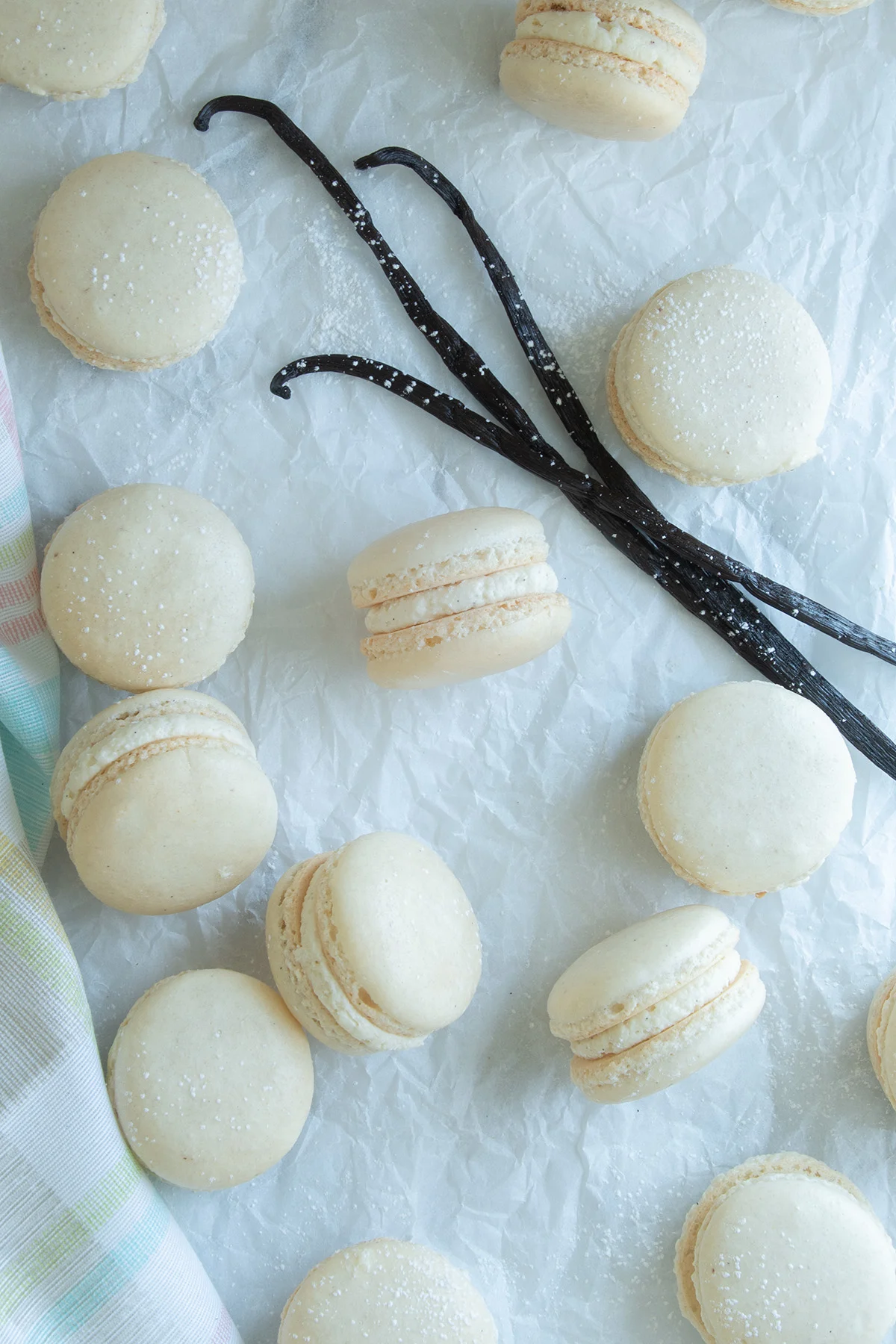
After making thousands of macarons, I’ve identified the steps that consistently make the difference between average results and excellent ones. If you’re learning to make French macarons, this recipe provides a clear reference point, with step-by-step photos and visual comparisons to help you recognize what’s happening at each stage.
Table of contents
Vanilla Macaron Ingredients
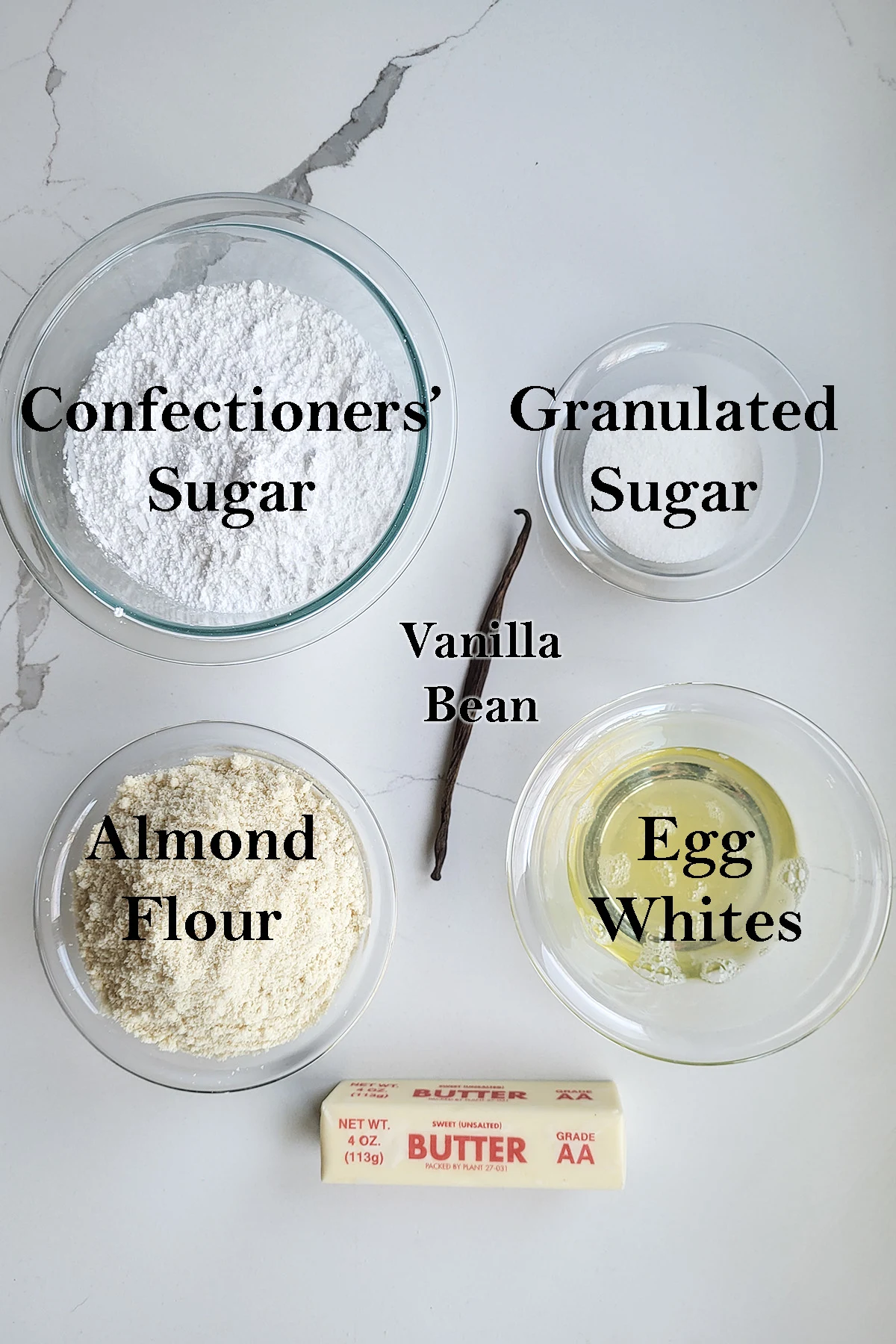
Ingredient Notes
- Egg Whites – Use egg whites that have been aged overnight in the refrigerator or previously frozen egg whites that have been thawed. Do not use pasteurized egg whites unless the carton specifically states they can be used for meringue.
- Almond flour – Use premade almond flour or grind blanched almonds in a food processor.
- Sugar – Powdered sugar absorbs moisture easily, which allows the whites to whip up to a light and stable meringue.
- Cream of Tarter – Acidifies and stabilizes the egg whites. Increased acidity helps prevent over-browning and supports a more stable meringue.
Vanilla Macaron Process Photos
Here’s what the recipe process looks like at each stage. Refer to the recipe card below for measurements and exact instructions.
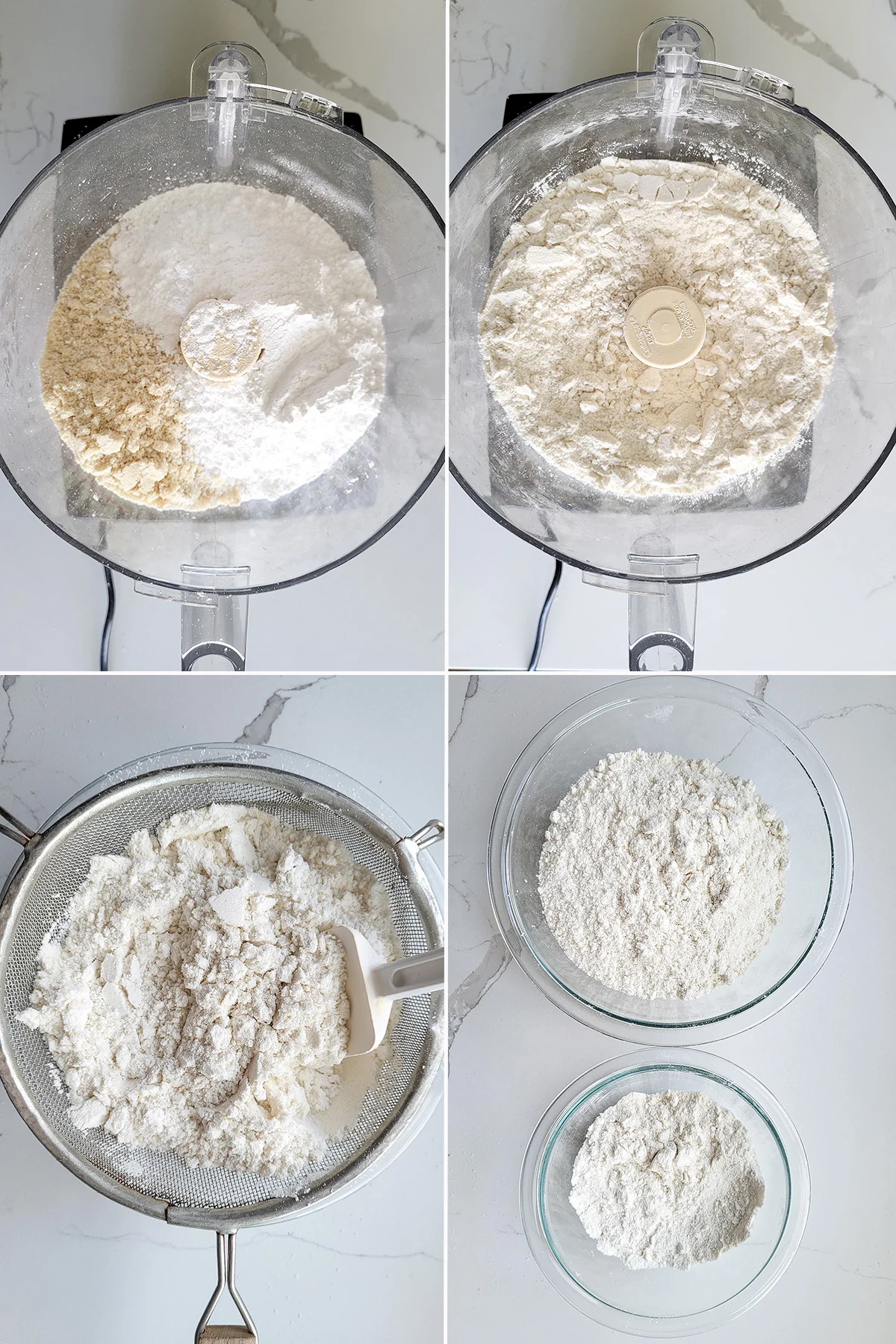
- Combine the almond flour and sugar in a food processor.
- Pulse to combine the ingredients.
- Sift the almond mixture through a fine sieve. Toss any larger bits of almond left in the sieve.
- Divide the almond base into two parts.
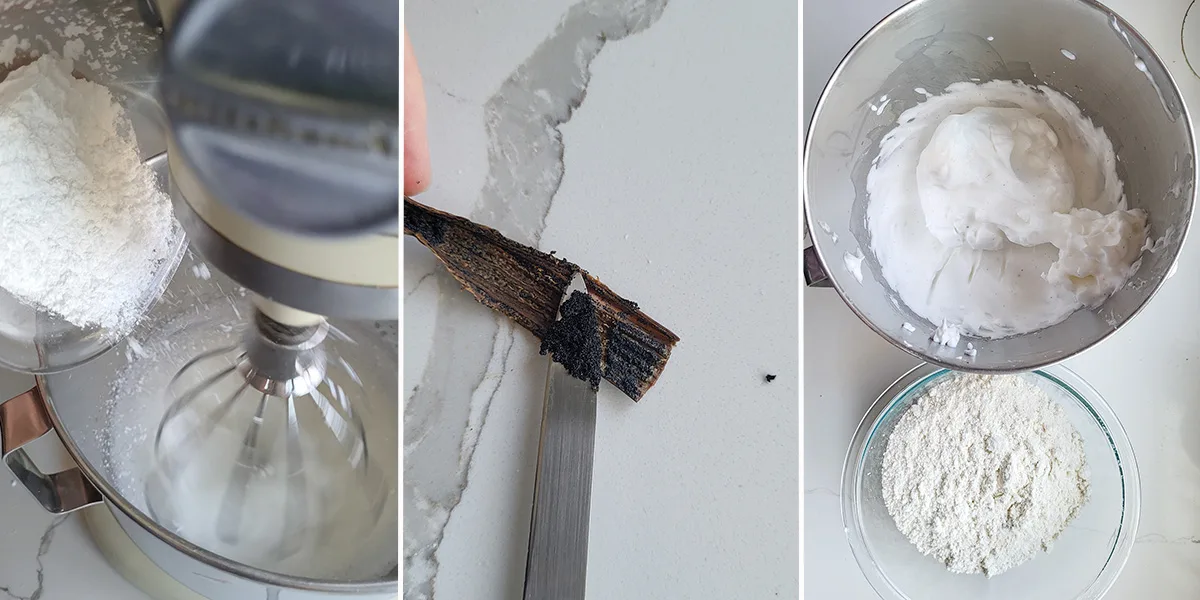
- Whip the egg whites to soft peak and begin adding the remaining powdered sugar.
- Scrape the seeds from half the vanilla bean and add them to the egg whites.
- Gather the whipped whites and the almond base.
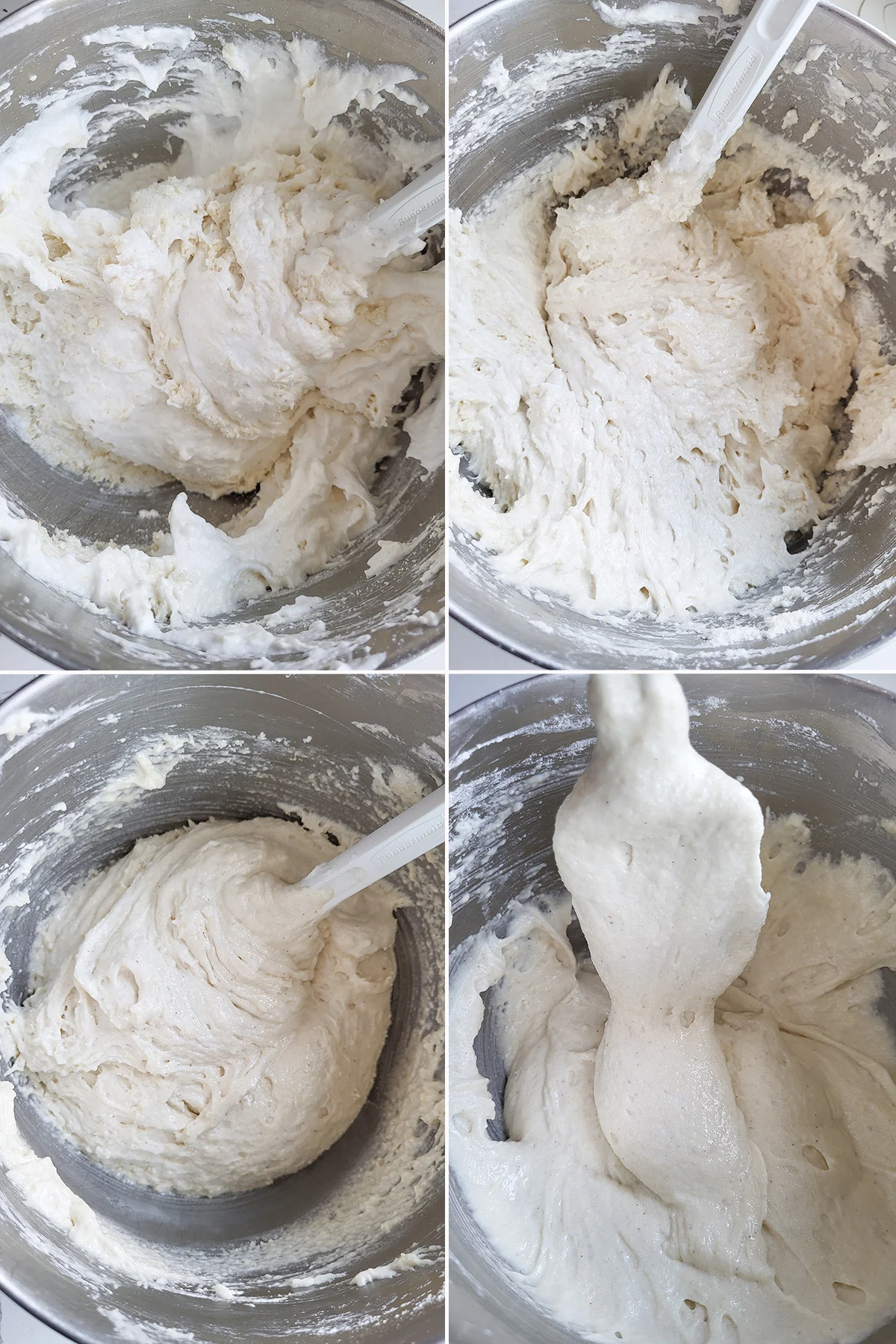
- Fold the almond base into the meringue into two parts.
- The macaron batter will start out quite rough but will gradually smooth out and come together.
- The final batter should be glossy and smooth, not thin and runny.
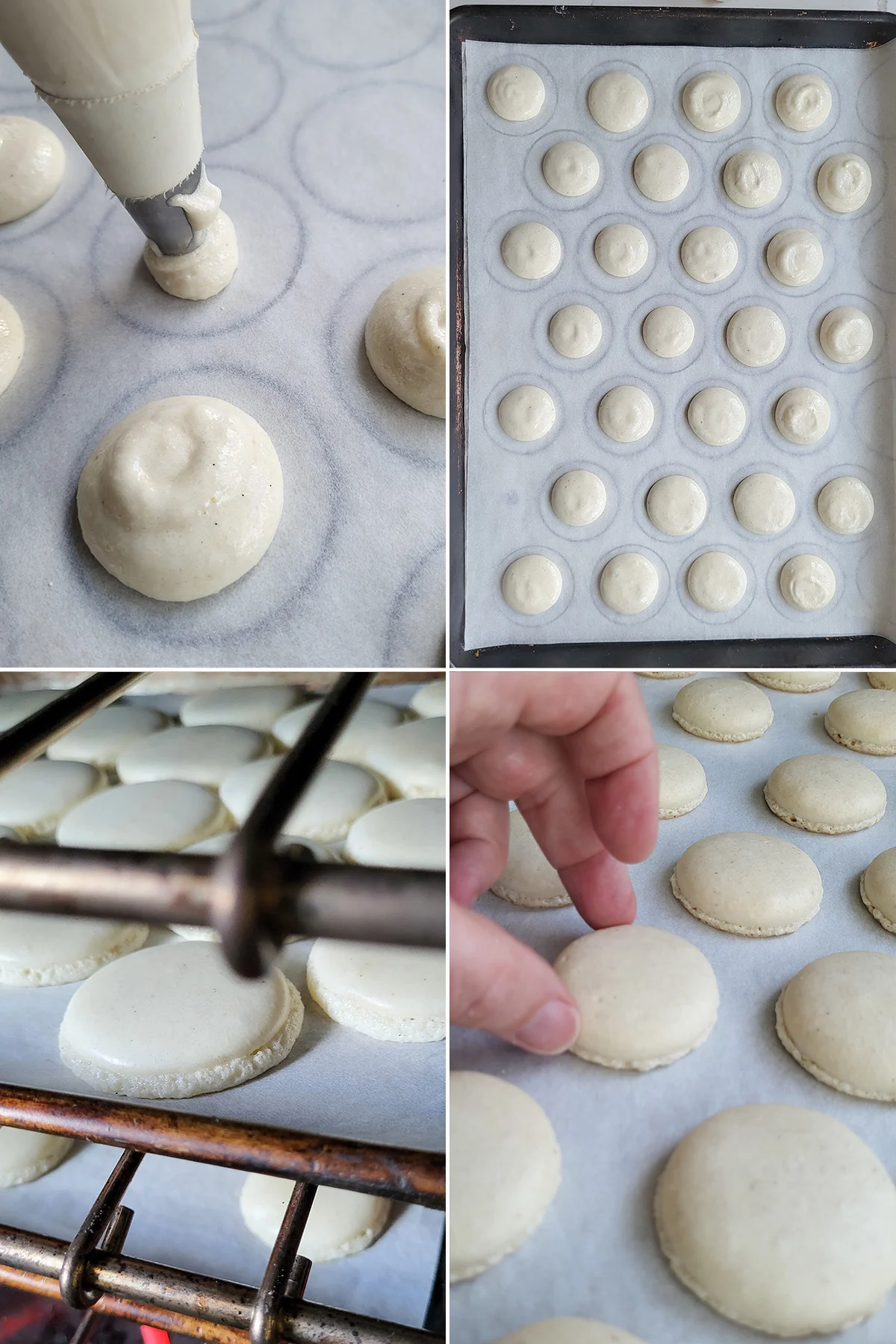
- Pipe the cookies using the circles as a guide for consistent size.
- Pipe slightly smaller than the circle as the batter will spread as it settles.
- The macarons should start to form a “foot” about 5 minutes after they go into the oven.
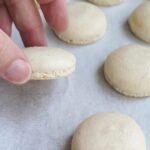
- To check if the shells are baked gently shimmy the top of the shell. If it jiggles separately from the “foot” the inside is still too soft. If it feels soft but is attached to the foot it’s done.
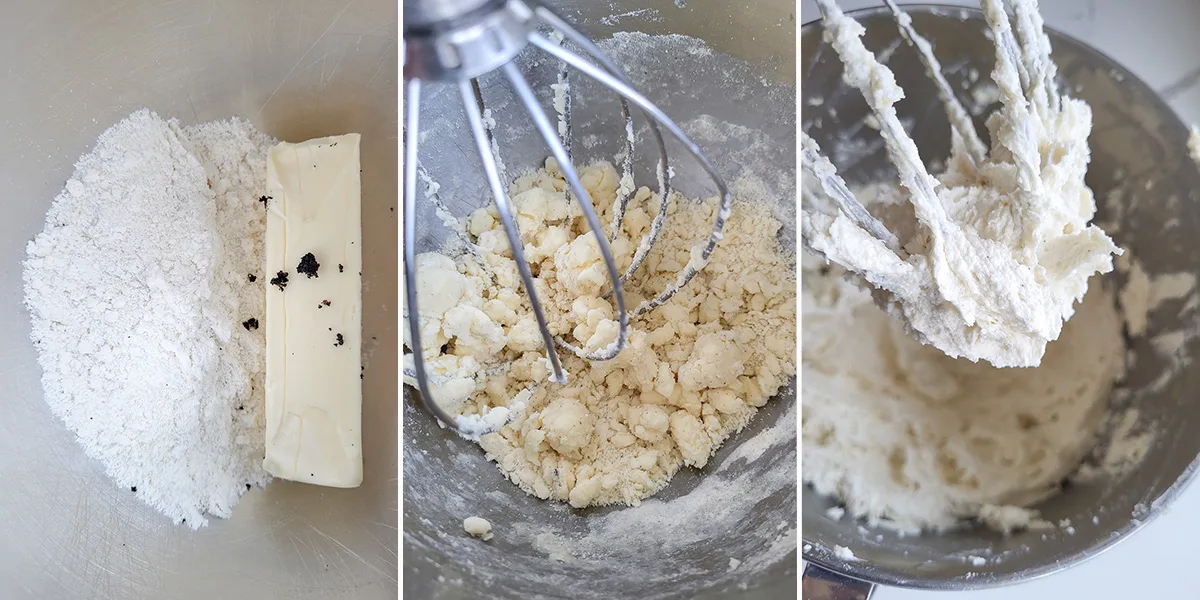
- To make the buttercream combine the remaining almond base, softened butter and remaining vanilla seeds in a mixer bowl.
- Mix to combine.
- Increase the speed and whip until light and aerated.
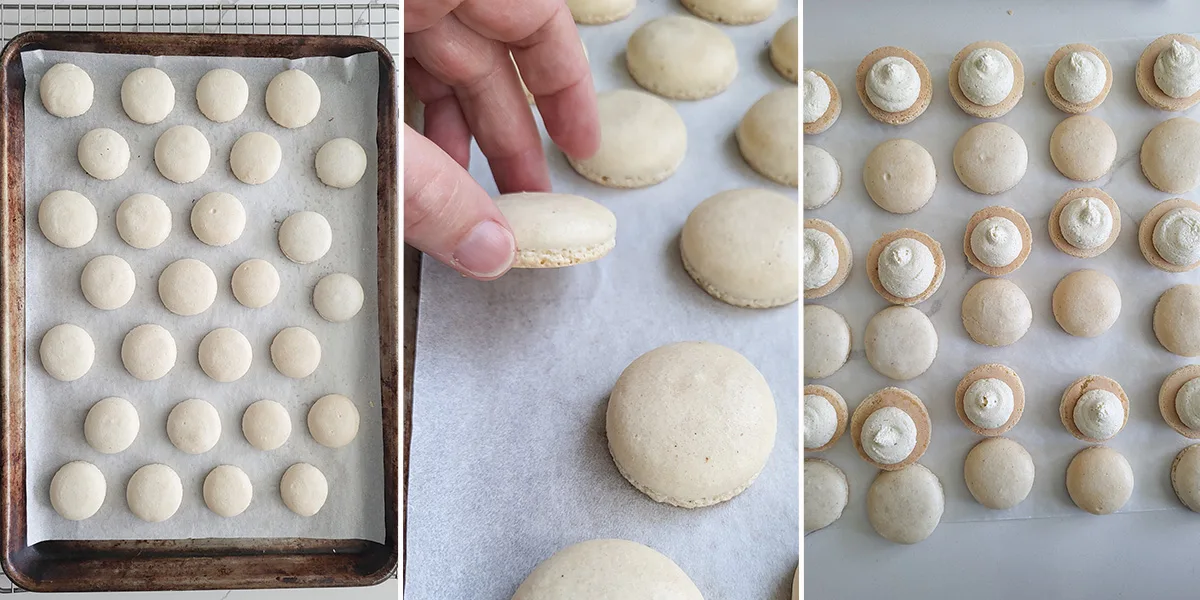
- Allow the macaron shells to cool completely.
- Macarons shells should easily separate from the parchment paper if they are baked correctly.
- Pair the shells up by size. Flip over one shell per pair and pipe buttercream onto the flat sides. Sandwich the cookies.
French Macaron Method and Troubleshooting
This section explains the key steps that determine macaron success, along with visual cues to help you recognize correct and incorrect results. Use it as a reference while you bake or to identify where the process went off track.
Ingredient and Preparation Fundamentals
- Weighing ingredients: Macarons require precision. Volume measures are not reliable enough for consistent results.
- Egg whites: Aged egg whites contain less excess moisture and whip higher and faster. This improves structure and consistency in the shells. Previously frozen egg whites behave similarly once thawed.
- Processing the almonds and Sugar: Even when using premade almond flour, process it with the confectioners’ sugar and then sift. Processing ensures a very fine, evenly distributed mixture and allows the sugar to absorb some of the natural oils from the almonds. This extra step produces smoother, shinier macaron shells. When I tested simply whisking the almond flour and sugar together, the shells baked up with a slightly rough surface. They were acceptable, but lacked the refined finish that defines a good French macaron.
- Sifting the dry ingredients: Always sift the almond flour and sugar after processing to remove lumps or larger nut pieces that can mar the shell surface.
- Drying the shells: Allow the piped shells to rest until the surface is dry to the touch. This sets the top and helps the shells rise cleanly to form a proper foot.
- Maturation: Refrigerating assembled macarons allows the shells to absorb moisture from the filling and improves both texture and flavor.
Macaron Batter: What to Look For
Properly mixed macaron batter should be smooth and glossy but still have structure. When drizzled onto itself, the batter should hold its shape briefly before slowly settling.
Overmixed batter becomes very shiny and runny. It spreads immediately after piping and will not hold its shape.
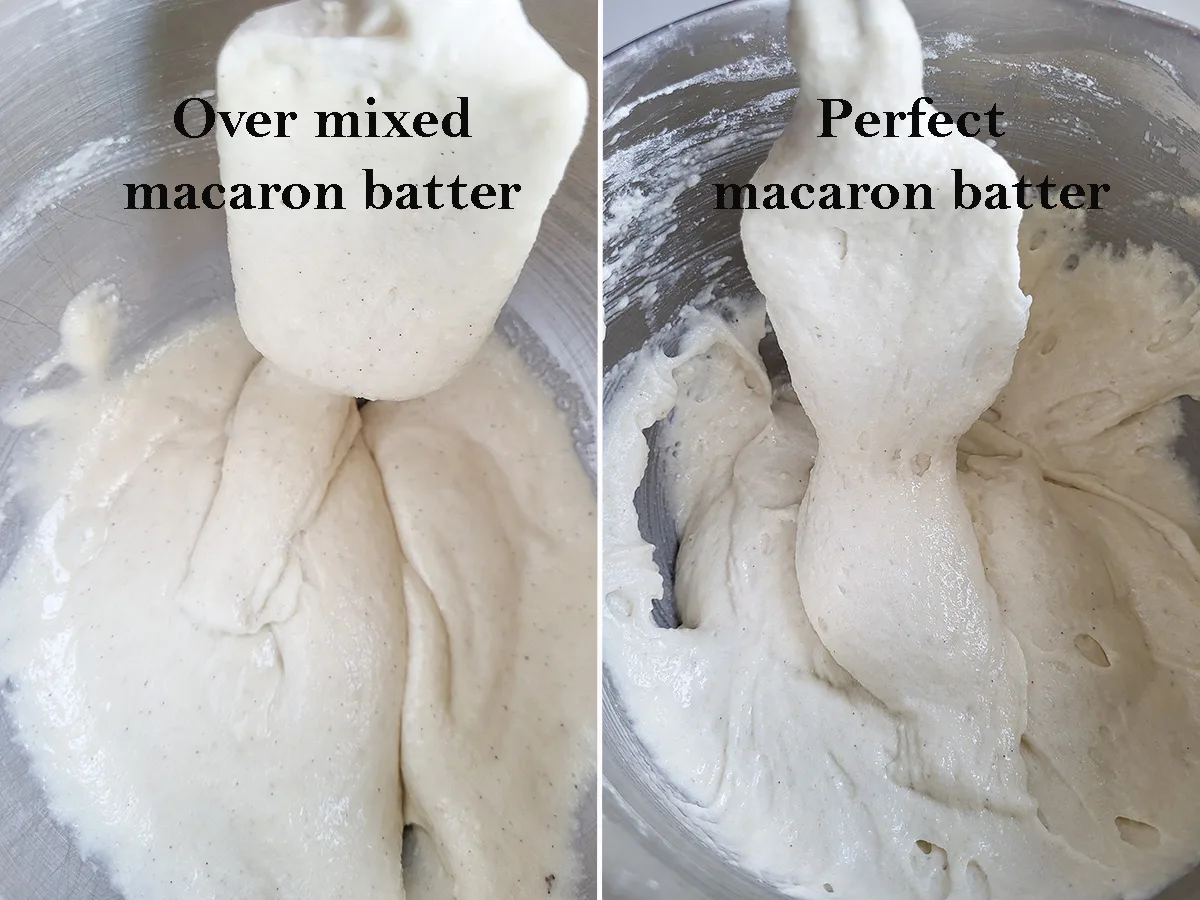
In the mixing bowl, properly mixed batter looks cohesive and satiny, not loose or watery. Overmixed batter loses structure and flows like a thick liquid rather than a soft paste.
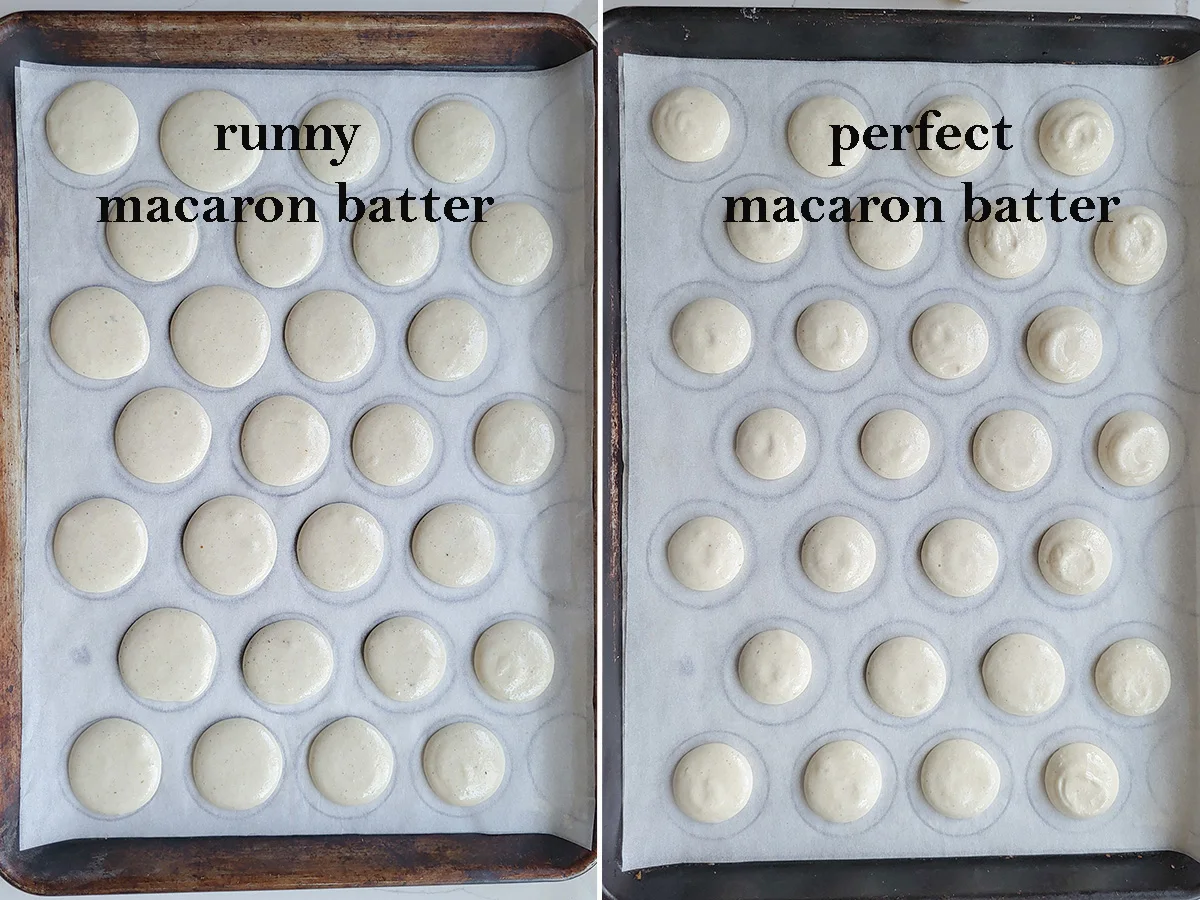
After piping, properly mixed batter will hold its shape briefly before slowly spreading. Overmixed batter spreads quickly, resulting in flatter shells with uneven edges.
Macaron Shell Behavior in the Oven
How macaron shells behave in the oven is largely determined by two factors: moisture and temperature. The shell surface needs to set quickly so the cookies rise straight up, forming an even foot. Excess moisture or excessive heat interferes with that process in different ways.
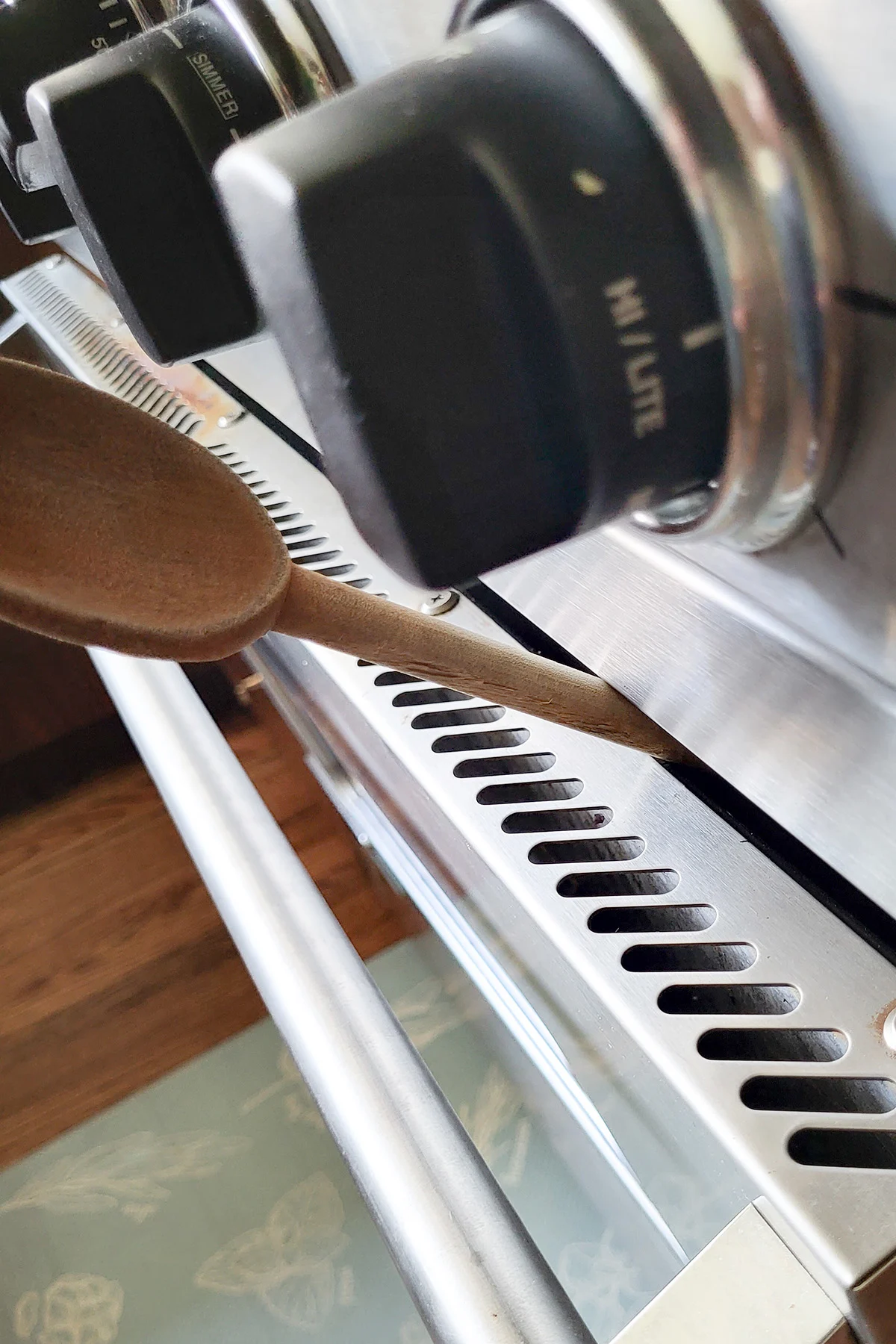
If your oven traps steam, excess moisture can prevent the tops of the shells from setting quickly enough. When this happens, the shells may crack or fail to form a proper foot.
Propping the oven door open with the handle of a wooden spoon allows moisture to escape and can dramatically improve shell structure in humid ovens. If your oven has a convection setting turn it on to keep the air circulating in the oven.
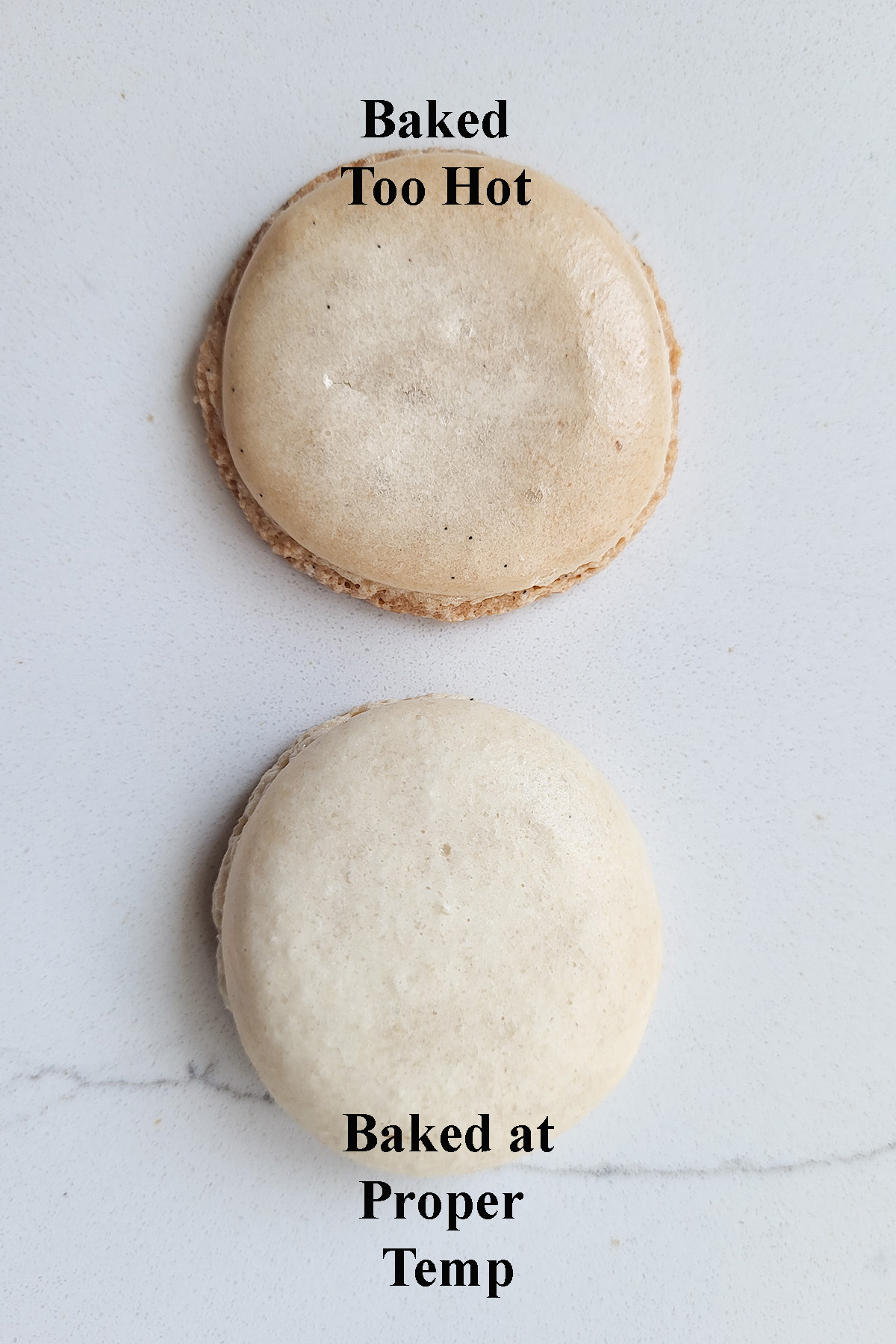
Macarons baked at too high a temperature tend to color more quickly and unevenly. The shells may develop a mottled surface, bake with an irregular texture, or stick to the parchment paper.
Macarons baked at too low a temperature can prevent the tops of the shells from setting quickly enough. When this happens, the shells may crack or fail to form a proper foot.
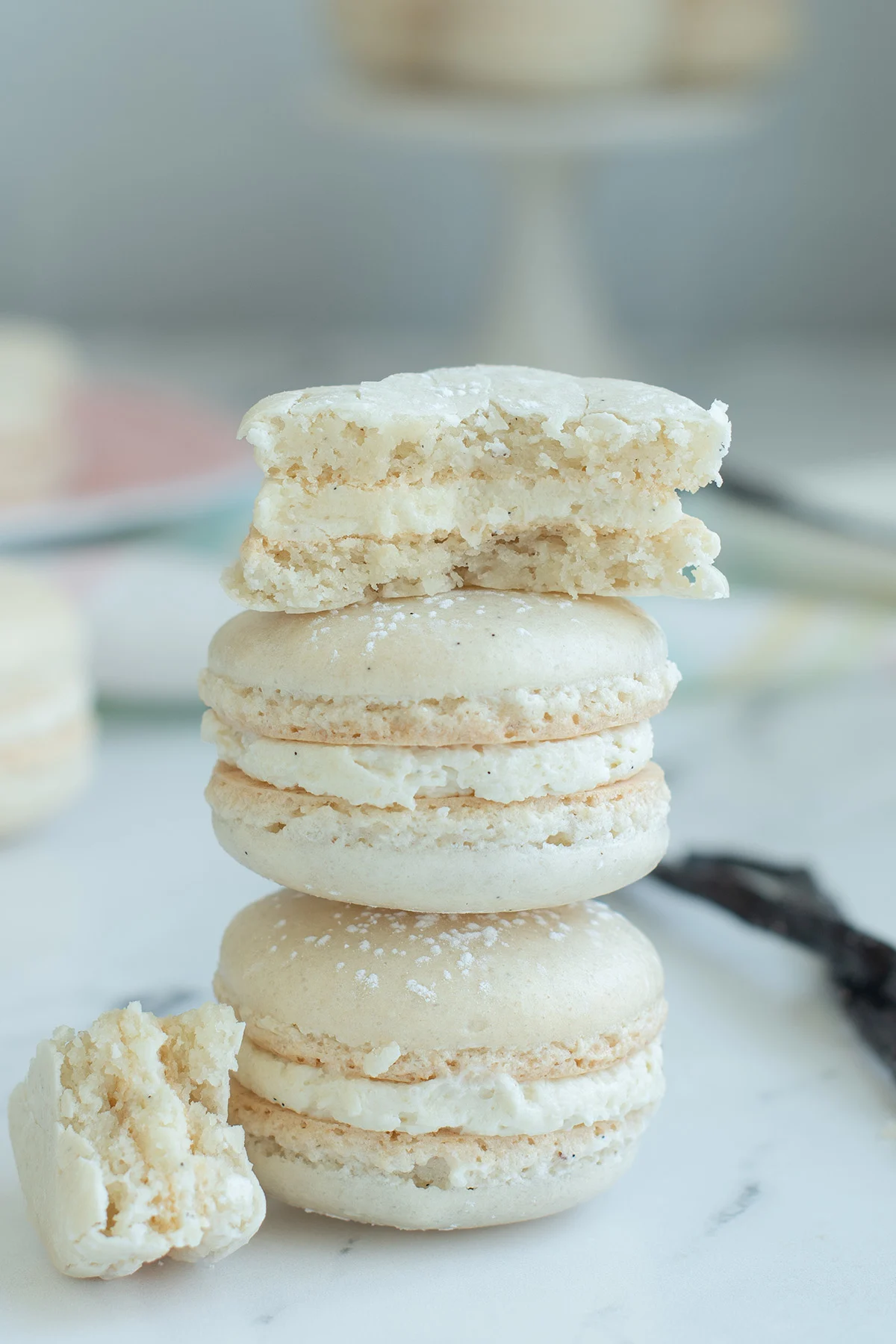
At the proper temperature, the shells bake with minimal browning, a smooth surface, and an even foot.
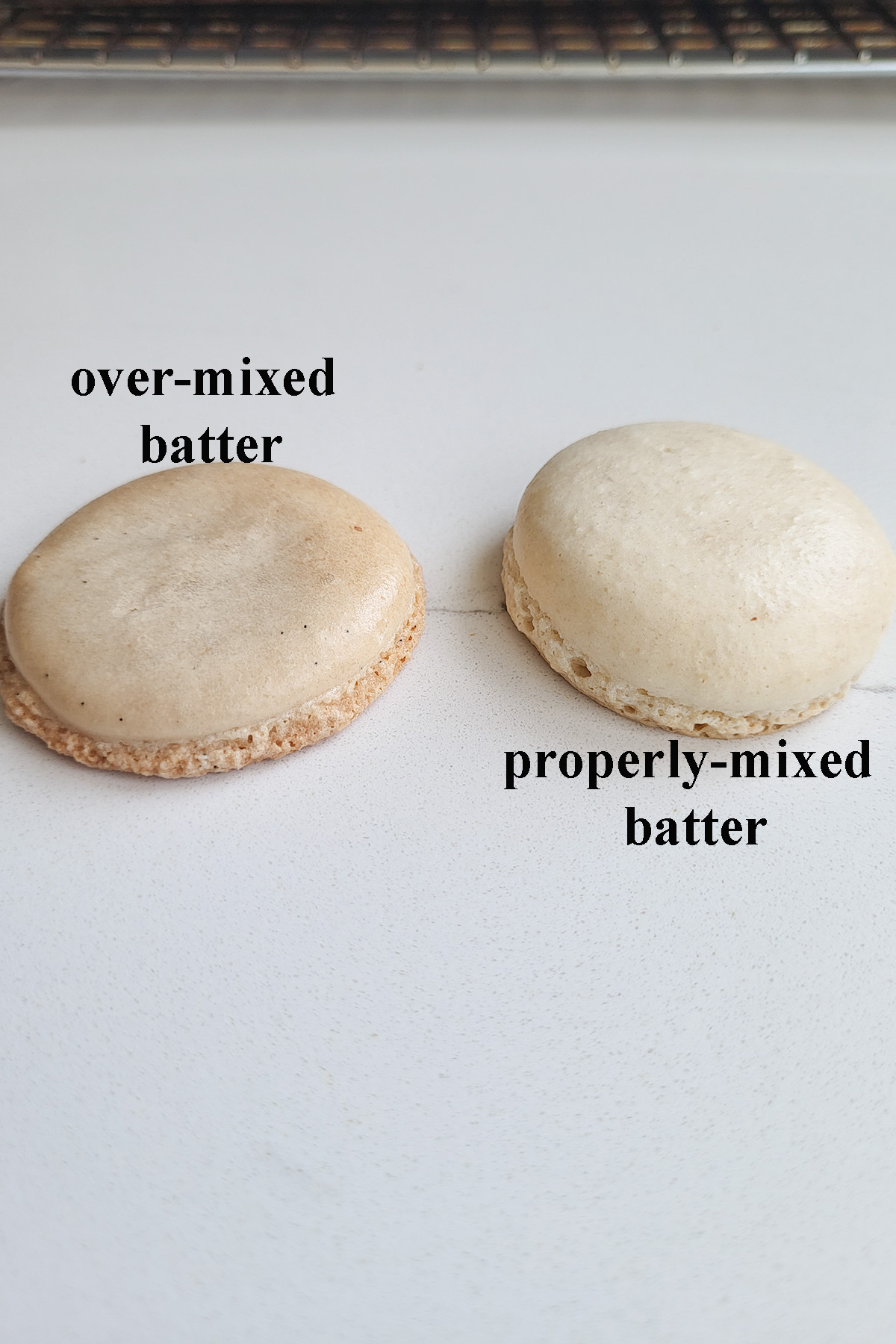
Batter consistency also affects how the shells bake. Macarons made from overly runny batter spread excessively, resulting in flatter, uneven shells.
Shells baked from properly mixed batter rise evenly, with a gently rounded top and a well-defined foot.
Macaron Storage
- Macarons can be held at room temperature for 2-3 days.
- Macarons can be refrigerated in a covered container for up to a week.
- You can freeze macarons for several weeks after they’re assembled, making them a reliable make-ahead dessert or gift.
Now that you’ve made this recipe what should you do with the extra yolks? Check out this collection of recipes that use extra yolks for some great ideas.
More French Macaron recipes:
- Chocolate Macarons
- Lavender Macarons
- Lemon Blueberry Macarons
- Strawberry Rosé Macarons
- 100% Pistachio Macarons
- Baileys Macarons
- Eggnog Macarons
If you love this recipe as much as I do, I’d really appreciate a star rating and a quick comment. Ratings and comments help my recipes show in search results. Thanks!
Vanilla Macaron Recipe
Ingredients
Macaron Base Mix
- 6 oz almond Flour
- 2 oz granulated sugar
- 8 oz confectioner sugar
Macaron Shells
- 3 large egg whites (aged, see note)
- 1 ½ oz confectioner sugar
- ¼ teaspoon cream of tartar
- 1 each vanilla bean
- 12 oz Macaron Base Mix
Buttercream
- 4 oz unsalted butter (room temperature)
- Remaining Macaron Base Mix
Instructions
Make The Base Mix
- Pulse 6 oz almond Flour, 2 oz granulated sugar and 8 oz confectioner sugar in a food processor to combine. Move the mixture to a sieve and sift into a bowl. Whisk the ingredients after sifting to be sure they are well combined. Divide the base – setting aside 12 oz (336g) for the macaron shells and the remaining for the buttercream filling.
Make the Macaron Shells
- Use a biscuit cutter to draw 24 2" circles on a 1/2 sheet of parchment paper. Line 2 baking sheets with parchment paper and put the paper with the circles underneath the parchment on one of the pans.
- Whip 3 large egg whites and ¼ teaspoon cream of tartar to soft peak. With the mixer running add 1 ½ oz confectioner sugar and the seeds from half of the vanilla bean. Whip to full peak.
- Gently fold the 12 oz Macaron Base Mix into the whites in two batches. Continue folding until it becomes soft and shiny, but not thin and runny. Scoop the batter into a pastry bag fitted with a round tip (or cut the tip of a disposable bag). Pipe the batter using the circles as a guide to keep the size consistent. Set the pan aside to allow the cookies to dry for 30-60 minutes. Meanwhile, preheat the oven to 300 °F.
- Touch the top of a cookie to make sure it's dry to the touch, it can be a bit tacky but shouldn't completely stick to your finger. Bake for 7-8 minutes then rotate the trays. Bake for another 5-6 minutes until the shells are dry and the centers are soft (see note).
- Allow the shells to cool completely. You can use a small offset spatula to release the shells from the parchment. Be careful handling the shells, it’s very easy to crack the smooth surface.
Make the Buttercream Filling
- Combine 4 oz unsalted butter with the Remaining Macaron Base Mix and the seeds from the other half of the vanilla bean. Whip on medium-high speed until the buttercream lightens in color and becomes aerated.
- Scoop the buttercream into a clean pastry bag fitted with a small plain tip or cut the tip of a disposable bag.
- Pair up the cooled shells by size. Flip over one shell per pair. Pipe buttercream over each flipped shell. Sandwich the cookies gently, handling the cookies by the edges and not the tops.
- The finished cookies should be refrigerated in a covered container for a couple of hours or overnight before serving. The cookies can also be frozen for several weeks.
Would you like to save this recipe?



As an Amazon Associate and member of other affiliate programs, I earn from qualifying purchases.
I’ve never made Macarons. In fact I think I’ve only tasted store bought Macarons once or twice in my life so I’m not sure how they are supposed to taste. I tried these mainly because I had a few different jars in my freezer with 3 egg whites in each jar from when I made recipes that used egg yolks so I thought it would be a good way to use my extra egg whites.
My result was less than perfect. I thought the flavor was off. It wasn’t a smooth vanilla flavor. It was almost as if the fresh vanilla bean was overpowering. Perhaps I should not use the whole bean next time. They were super sweet (too sweet in my opinion) and the texture was somewhat gritty almost like the granulated sugar had not dissolved fully. I think the buttercream filling was gritty and the shells were super sweet and the combination was sweet on steroids. Not sure if I needed to whip the buttercream longer or if that’s the texture it was supposed to be. The buttercream looked light and airy, like buttercream usually looks but tasted gritty. Finally the shells were a little gummy on the inside. Not sure if they should have stayed in the oven a little longer but they definitely tasted undercooked to me. The tops were shiny and dry and the centers were soft to the touch when I took them out. They cooked a total of about 15 min and I rotated the pan halfway through like you suggested in the recipe. After cooling they were difficult to remove from the parchment paper. Even using a small offset spatula like you recommended, a small amount of the cake stuck to the paper and the spatula just got caked up and sticky because they were so gummy.
I’m planning to try again with the strawberry and the lemon blueberry flavors because I have all the ingredients for both in the house.
Any recommendations for better texture or better overall outcome?
Did you read through the post with the suggestions for macaron success?
Yes I did, and i even watched the video of the lemon ones. Just looking back at the tips again I’m thinking my batter may have been over mixed. Also my egg whites had been frozen for about a month, so i’m wondering if they maybe had too much water in them after thawing. I let them thaw in the jar on the counter and let them come fully to room temperature before using.
Planning to try again.
Yes, often the problems lead back to over mixing or under mixing. Also, my oven holds a lot of steam and I need to prop the door open while the macarons are baking. You can try that too.