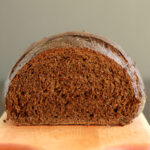
Sourdough Pumpernickel Bread
This sourdough pumpernickel bread is a dark, hearty loaf with deep rye flavor and a sturdy crumb that’s ideal for sandwiches. Coffee, cocoa, toasted bread crumbs, and barley malt syrup contribute color and complexity without making the bread sweet. The dough can be mixed and baked in one day or finished with an overnight cold fermentation for more developed flavor.
servings
Start Cooking
Ingredients
Rye Starter
- 4 ounces unfed sourdough starter ((100% hydration))
- 2 ounces warm water (¼ cup)
- 2 ½ ounces rye flour (½ cup, see note)
Dough
- 10 ounces brewed coffee (1 ¼ cups, room temperature)
- 1 ½ ounces barley malt syrup (2 tablespoons (see note 2))
- 1 tablespoon cocoa powder
- 1 ½ teaspoons table salt
- 5 ounces rye flour (1 cup)
- 2 ounces toasted bread crumbs (½ cup (see note 3))
- 2 ½ ounces whole wheat flour (½ cup)
- 5 ounces bread flour (1 cup)
Instructions
Feed the Rye Starter
- Combine the 4 ounces unfed sourdough starter, 2 ounces warm water and 2 ½ ounces rye flour.
- Cover the bowl and let it ferment about 6-8 hours at room temperature (you can do this the night before and continue making the dough in the morning).
Make the Dough
- In the bowl of a stand mixer with a dough hook or a large a large mixing bowl, combine the rye starter with 10 ounces brewed coffee, 1 ½ ounces barley malt syrup, 1 tablespoon cocoa powder, 1 ½ teaspoons table salt, 5 ounces rye flour, 2 ounces toasted bread crumbs and 2 ½ ounces whole wheat flour. Mix to combine.
- With the mixer running, add 5 ounces bread flour. If working by hand, stir in as much of the flour as you can, then turn the dough out onto a lightly floured surface and knead in the remaining flour. Knead 5 minutes. The dough will start out quite sticky. After kneading the dough should cling to the hook and clear the sides of the bowl. Turn the dough out onto a lightly floured surface and knead into a ball. The dough will still be slightly sticky.
- Place the dough into an oiled bowl, turning once to coat. Cover and set at room temperature for 1 hour. After an hour, working from four corners of the dough (still in the bowl) use your hand to lift the top edge of the dough over into the middle of the dough. Repeat with the other 3 sides then flip the dough over. Cover and set at room temperature for another hour. Repeat the folding procedure 2 more times so the dough rises for a total of 3 hours. By now the dough should be lively, elastic and airy. If the dough is still sluggish give it another hour or two at room temperature. After the initial fermentation the dough can be refrigerated for up to 2 days before baking.
- Turn the dough out onto a floured surface and knead into a smooth ball and let it rest for 10 minutes. Pat the dough to a 9" oval then roll the dough into a torpedo shaped loaf. Transfer the loaf to a sheet pan lined with parchment paper or onto a baking peel dusted with cornmeal. If you want to bake in a Dutch oven shape the dough in to a round (boule) and preheat the pan in the oven.
- Cover the dough with plastic wrap or a damp kitchen towel and rise until about doubled in volume (about 2 - 2 ½ hours). The rising time will vary base on how active your starter was, the temp of the dough and the ambient temperature.
- While the dough rises preheat the oven to 375 °F. If you have a baking stone put it in the oven to preheat. When the bread is risen, use a sharp knife or blade to slash the top of the bread 4-5 times or do 1 long slash along the length of the loaf.
- If using the Dutch oven to bake follow these directions: Remove the preheated pan from the oven and remove the lid. Use the parchment paper to lift the loaf into the Dutch oven. Replace the lid on the pot and slide it into the oven. Bake for 20 minutes. Remove the lid from the Dutch oven. The loaf should be well risen and pale in color. Continue baking another 20 minutes until the loaf is nicely browned and beginning to crisp. Remove the pan from the oven. Use the parchment to lift the loaf out of the pan.
- If baking on a sheet pan or baking stone bake until the temperature reaches 200°F in the center of the loaf, about 35 minutes.
Would you like to save this recipe?


As an Amazon Associate and member of other affiliate programs, I earn from qualifying purchases.
Notes
If measuring the flour by volume use the “dip & sweep” method. That is, dip the measuring cup into the flour bin, overfill it, then sweep away the excess.
You can use 1 tablespoon of molasses plus 1 tablespoon of honey in place of the barley malt syrup.
Grind old slices of rye, pumpernickel or sourdough bread to fine crumbs then toast until deeply browned, but not burnt. You can also use unflavored commercial bread crumbs.
Have you tried this recipe?Mention @eileen.bakingsense or tag #bakingsense!